

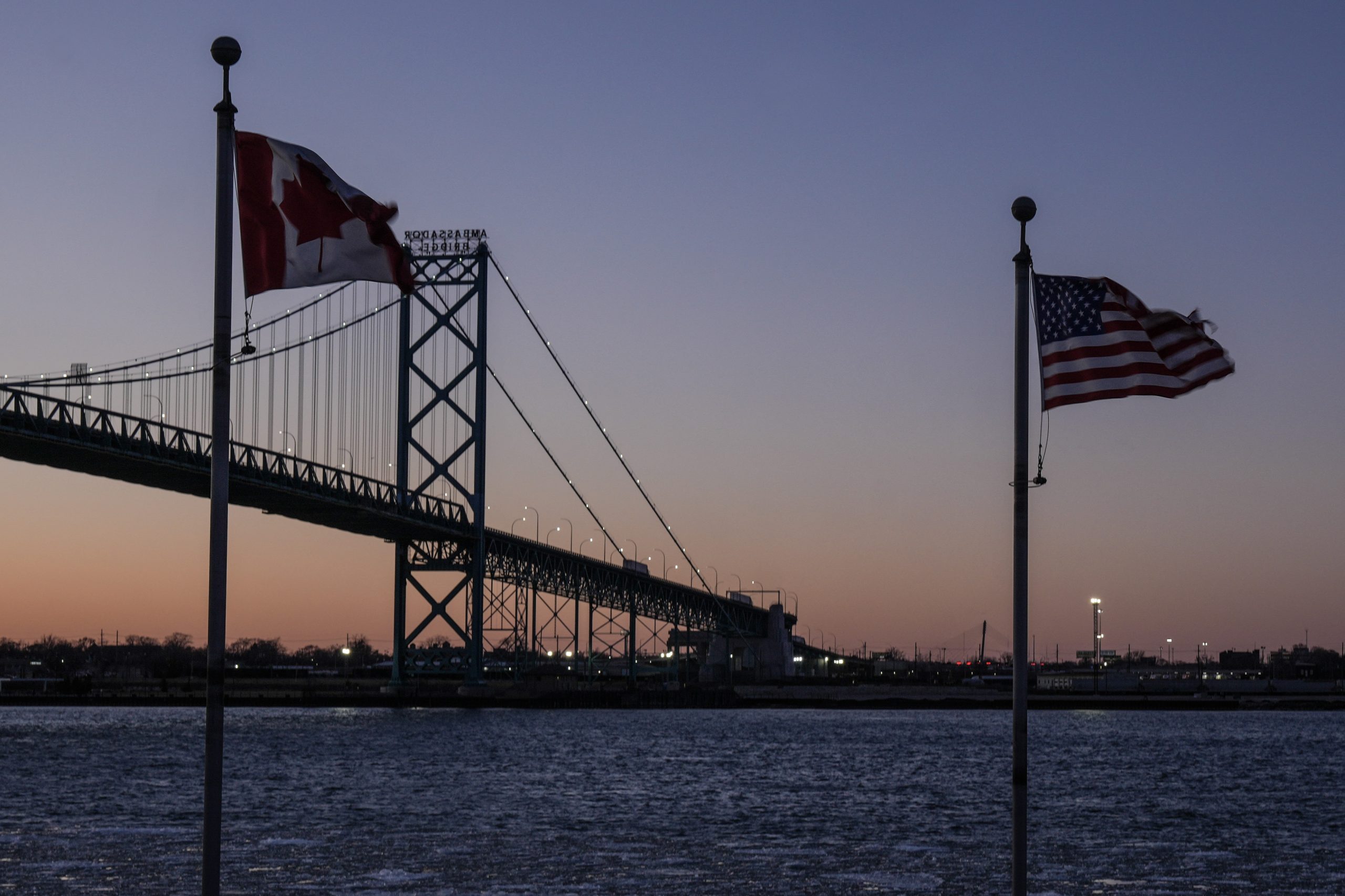
Canadian prime minister Brian Mulroney was excellent at establishing personal relationships, including with his caucus and American presidents. But with his passing last year, he will not have a chance to rethink his rejection of arguments against developing a close relationship with the United States made by former prime minister John Turner when the two had a heated exchange over free trade decades before U.S. President Donald Trump entered politics.
But Canada will eventually find out if Turner presciently portended just how much trouble our economic ties to the United States would eventually cause Ottawa on October 25, 1988, when the following war of words took place:
TURNER: “Once any country yields its economic levers—
MULRONEY: Don’t you impugn my motives or anyone else’s—
TURNER: Once a country yields its energy—
MULRONEY: We have not done it.
TURNER: Once a country yields its agriculture—
MULRONEY: Wrong again.
TURNER: Once a country yields itself to a subsidy war with the United States—
MULRONEY: Wrong again.
TURNER: On terms of definition then, the political ability of this country to remain as an independent nation that is lost forever and that is the issue of this election, sir.”
During what has been called “the mother of all election debates,” Turner went on to state: “We built a country east and west and north. We built it on an infrastructure that deliberately resisted the continental pressure of the United States. For 120 years we’ve done it. With one signature of a pen, you’ve reversed that, thrown us into the north-south influence of the United States and will reduce us, I am sure, to a colony of the United States because when the economic levers go, the political independence is sure to follow.”
Today, it is clear that policy and commercial relationships originating with personal chemistry, including the nation building by Mulroney, and solidifying with the rule of law, may not be sustainable. This should be a wake-up call for Canadian directors.
Since the original Free Trade Agreement between Canada and the United States in 1989, Canadian industry and companies – and their boards of directors – have become integrated with the United States. Up to 85 per cent of Canadian exports are tariff-free under the Canada-United States-Mexico Agreement (CUSMA).
The result, for over thirty-five years, has been that Canada has integrated many industries, most notably automotive, and managed to successfully insulate certain others from American competition (e.g., dairy, banking) to preserve autonomy given our size differential. But the future could look much different thanks to the new protectionist policies of our largest trading partner, which imposed prosperity threatening tariffs on our nation earlier this year.
Currently, as this article is being posted anyway, there are no official negotiations occurring on Trump’s tariffs or the renewal of CUSMA. But if and when talks seriously start, Washington will likely seek trade concessions from Ottawa, and the list of concessions the Trump administration may seek is long.
Here are fifteen:
- Discontinuing government-funded anti-tariff ads in the United States.
- Discontinuing manufacturing cars in Canada by American automobile companies.
- Unencumbered access for the sale of U.S. agricultural and dairy products within Canada.
- Unencumbered access for the sale of U.S. alcohol within Canada.
- Unencumbered access for U.S. banks to operate within Canada.
- Facilitating of U.S. investment in certain sectors within Canada, including water, critical minerals, telecommunications, energy resources and infrastructure services.
- Refraining from discriminating against U.S. goods or services.
- A certain monetary threshold and time period for job-creating investment in the U.S., by Canada.
- Removal of all procurement restrictions on U.S. companies, e.g., within “buy Canadian” or similar, e.g., provincial and municipal, mandates.
- Removal of any Canadian-imposed taxes on U.S. companies.
- Unencumbered access for U.S. companies to Canadian television, direct-to-home broadcast services and online streaming.
- Removal of any plastic or other similar restrictions on U.S. products.
- Removal of energy restrictions during times of surplus or transmission congestion.
- Removal of a French language (and possibly metric) requirement on American goods sold in Canada.
- Certain other incentives, perquisites, investments, or requirements, e.g., the purchase of American F-35 fighter jets by Canada.
Given the above, it is not surprising that Canada and the United States have yet to reach an agreement. Amid the uncertainty, however, we do know that the U.S. appears to be out to hollow out our national economy. And as President Trump sees it, America “holds all the cards.” Meanwhile, Canadian Prime Minister Carney has stated that the former trading relationship with the United States is “over.” Under his leadership, Canada seeks to double non-U.S. exports by 2035.
Simply put, Carney is not in denial. which is why Ottawa has been actively seeking or strengthening trade relationships with dozens of countries, almost on a weekly basis. Boards of directors should be following Ottawa’s lead. Instead of governing in denial, they should be overseeing the diversification of trading relationships, while preparing, as necessary, for one or more of the following five worst-case scenarios:
- There may be, ultimately, no trade deal between Canada and the United States, or if there is one, it will be narrow and not omnibus in nature.
- Existing tariffs (sectoral and non-CUSMA compliant) may continue, perhaps indefinitely or permanently, even beyond the Trump administration.
- The concessions identified in the above section may mean that the U.S. may, ultimately, withdraw or wind down from CUSMA, as no deal (for Canada) may be better than a bad deal; or, to put less charitably, in the words of Warren Buffett, “you can’t make a good deal with a bad person.”
- Formerly tariff-free CUSMA compliant goods may become tariffed at the current non-CUSMA 35 per cent level (or lower, depending).
- The de minimis exemption of US$800 may not be reinstated.
What Should Boards be Doing?
There currently exists differential impact between Canadian tariffed sector companies, and non-tariffed CUSMA-compliant companies. However, it cannot be ruled out that Canada will end up in what U.S. Ambassador to Canada Pete Hoekstra calls the “the lowest tariff bucket” we can hope to be offered. In other words, approximately 85 per cent of Canadian exports to the U.S. may be subject to a minimum tariff between Canada’s current 35 per cent on non-CUSMA goods to the 10 per cent baseline of the United Kingdom. The sector-specific tariffs, e.g., aluminum, automobiles, copper, softwood lumber, steel and wood products, may or may not be lowered or continue at current levels, depending on any final agreement (if one is reached).
In this environment, it is important to remember that companies do not fail, boards do. Day-to-day management may focus on the here and now, but corporate directors should be forward-focused. “What is coming, what is plausible, and are we prepared?” are questions boards should ask management during volatile times.
Therefore, boards of directors, including at non-tariffed companies, should be taking the following twelve steps:
- Tariff scenario and trade diversification plans should be reviewed by the board, including new target markets and corridors for the company’s goods.
- Supplier resiliency, customer development, financial and legal updates should be provided to the board by management.
- Supplier resiliency plans should include disruption within the supply chain, succession and transition planning, and regulatory procurement changes.
- Government projects and regulation that impact or involve the company should be reviewed by the board.
- Macroeconomic effects impacting the company because of tariffs should be reviewed by the board, including inflation, interest rates, the dollar and consumer demand.
- Regulatory changes to enhance productivity, including investment return, tax changes, and competition barriers, should be reviewed by the board.
- The board should adopt a partnering and agile stance with management, which means providing insight and the benefit of director expertise.
- Management should provide real-time candor and reporting to the board, looking forward as much as possible.
- Competency matrixes for the board should be updated, including retirement of certain steady state or past competencies, and incorporation of current competencies including experience under fire, business development, policy making, international (non-U.S.) experience, and capital and project management.
- Certain other competencies of directors may be reviewed, including target market presence, language fluency, and prospective customer and supplier contacts for the company.
- The conflict-of-interest policy for directors should be reviewed given the potential for boardroom schisms.
- A training refresh should be provided on obligations of directors under distress and Canadian law.
Given the unpredictable nature of the Trump administration, boards should be taking these steps even if some deal is announced. Lastly, like always, individual directors should ensure they add value to the board by doing the following:
- Keeping current, including with customer and other opportunities and regulatory changes that affect the company and its industry.
- Reviewing alerts and briefings on external changes, including from primary sources such industry and company updates, Canadian prime minister updates, and U.S. presidential action advisories.
- Reviewing quality and reliable news sources (e.g., newspapers and newscasts) covering events and developments that may impact the company.
- Working collaboratively with other directors and members of management, and shoulder one’s workload.
- Arriving fully briefed and prepared to board and committee meetings in order to contribute effectively.
- Always acting in the best interests of the company, without primacy or bias to any stakeholder or oneself.
- Knowing when or if it is time to stand down and retire from the board, gracefully, without making it awkward.
In the current environment, planning for the above worst-case scenarios should be on the table for board review, put there by directors if necessary. Because management may hope for the best, directors can never operate in denial.
About Author
Richard Leblanc is Professor of Governance, Law, and Ethics at York University, editor of The Handbook of Board Governance (Wiley, 2024), and independent advisor to boards of directors.


Trackbacks and Pingbacks